
The history of footwear - how shoes have evolved over the millennia
From simple leather cave covers to high-tech sneakers, the history of footwear is a fascinating journey through the millennia. Shoes have evolved from a practical foot protection tool into a status symbol, a fashion statement and a work of technology. Discover how footwear has changed over the centuries.

From cavemen to the present day - the beginnings of footwear
Footwear has accompanied humanity for thousands of years, and its history is a fascinating story about the evolution of societies, technology and fashion. The first shoes were created out of a simple need - to protect feet from cold, stones and hot sand. Today, they are not only an element of clothing, but also a symbol of social status and an expression of personal style.
The oldest preserved footwear dates back about ten thousand years. A leather shoe made of a single piece of cowhide was discovered in a cave in Armenia, perfectly preserved thanks to the dry climate. This discovery proves that already in the Stone Age, people were able to produce complex everyday objects.
Over the centuries, shoes have evolved from simple leather covers to refined works of craftsmanship. Not only the materials and manufacturing techniques changed, but also the social and cultural meaning of footwear. From a practical tool to a symbol of power and wealth, the history of shoes is a mirror of the history of humanity.

Antiquity and the Middle Ages - shoes as a status symbol
Ancient Egypt – papyrus sandals
In ancient Egypt, sandals made of braided papyrus, reed or leather were popular. Their shape and material depended on the social position of the owner. Pharaohs wore ornate sandals with gold applications, while commoners went barefoot or in simple sandals. The Egyptians believed that footwear had spiritual significance and often placed them in graves as equipment for the afterlife.
Ancient Greece and Rome – the first styles
The Greeks and Romans developed the art of shoemaking to the level of artistic craftsmanship. Sandals with several strips of leather wrapping the foot and calf were popular in Greece. The Romans introduced caligae - military sandals with a thick sole and metal studs for durability. A senator was allowed to wear special red shoes as a sign of his status. It was in ancient Rome that left and right footwear was first differentiated.
Middle Ages - symbolism of power
In the Middle Ages, the length of the toe of the shoe indicated social position. The nobility wore poulaines - shoes with elongated, sometimes absurdly long toes, which had to be supported by chains. The higher the status, the longer the tip. The Church tried to ban this custom several times, considering it a sinful vanity. Ordinary people wore simple ankle-length leather shoes.
Renaissance and Enlightenment – experiments with form
Renaissance - the birth of women's heels
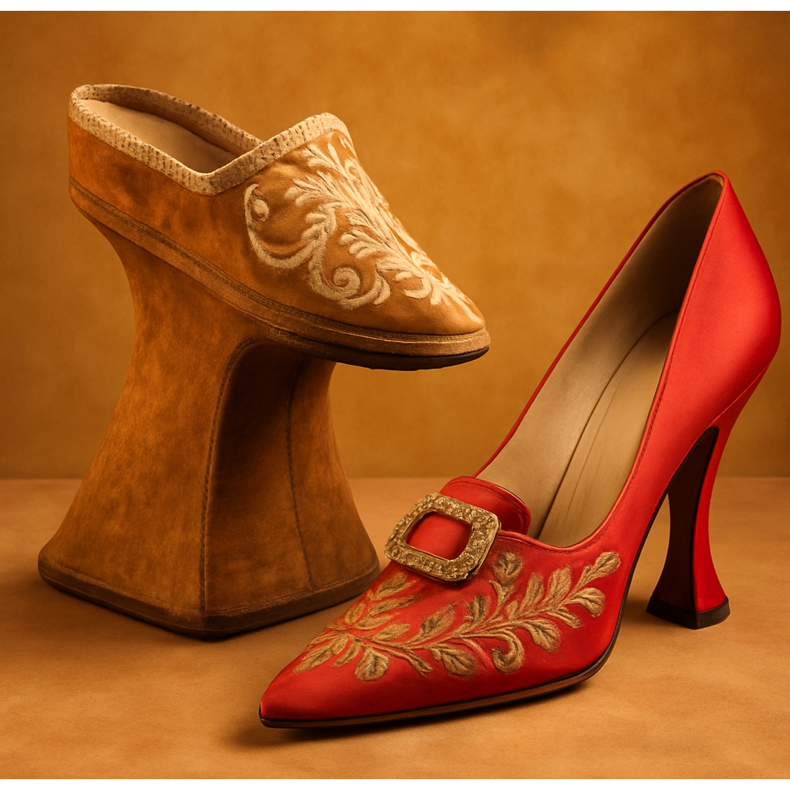
In the 16th century, chopins appeared in Italy - platforms reaching up to one and a half meters high. Venetian women wore them as protection from the mud on the streets, but they quickly became a symbol of wealth. Higher platforms meant higher social standing. Walking in them required the help of servants, which only emphasized the status of the owner.
Baroque and rococo – high heels for men
In the 17th century, King Louis XIV introduced the fashion of red heels for the aristocracy. Sam was only five feet five and wore high heels to appear taller. Men and women were equally likely to wear decorative high-heeled shoes, often richly decorated with embroidery and buckles. The color red was reserved exclusively for the king and his immediate surroundings.
18th century – division into left and right
It was only at the end of the 18th century that shoes began to be mass-produced, divided into left and right feet. Previously, footwear was symmetrical and adjusted to the foot when worn. This revolution significantly improved comfort of use, although some conservative shoemakers opposed the innovation.

The modern era – democratization of footwear fashion
Industrial revolution – mass production
The 19th century brought the greatest revolution in the history of footwear. The invention of the sewing machine by Isaac Singer and the mechanical production system significantly reduced the cost of making shoes. For the first time in history, the average person could afford more than one pair of shoes. The first shoe factories were established, and craft workshops began to give way to industrial production.
Sports and specialist shoes
At the end of the 19th century, the first sports shoes appeared. In the 1980s, Keds released sneakers with a canvas upper and a rubber sole. Adidas and Puma, founded by the Dassler brothers in Germany, revolutionized the sports footwear market. Each sport discipline has gained dedicated footwear tailored to specific needs.
20th century fashion
The 20th century was an era of fashion experiments. The 1920s brought strappy stiletto sandals. In the 1950s, Christian Dior introduced high heels, which are still a symbol of femininity. The 1960s were the era of go-go boots - high boots with mini skirts. Punk in the 1970s introduced heavy boots with metal studs. Each decade had its signature shoes.

Present and future – shoes in the 21st century
Technology and innovation
Contemporary footwear is a combination of traditional craftsmanship and advanced technology. Shock-absorbing EVA foam soles, Gore-Tex membranes ensuring waterproofness, antibacterial insoles - these are just some of the innovations of recent decades. 3D printing allows you to create personalized shoes that perfectly fit the individual foot anatomy.
Sustainable fashion – ecology in footwear
Contemporary footwear fashion is increasingly focusing on sustainability. Manufacturers use recycled materials, organic cotton, vegan leather from pineapple or mushrooms. The slow fashion movement promotes shoes that are ethically made, durable and can be repaired instead of thrown away.
Sneakers as a cultural phenomenon
Sports shoes have transformed from functional footwear into an object of cult. Limited edition sneakers reach astronomical prices at auctions. Sports brands collaborate with fashion designers and celebrities to create products that are works of art. Shoe collecting has become a global hobby.
The future of footwear
The future of footwear promises to be fascinating. Intelligent shoes with sensors monitoring activity, self-tying laces known from science fiction films, shoes that adapt to the shape of the foot - all this is no longer fantasy. Blockchain technology allows you to verify the authenticity of luxury footwear, and augmented reality allows you to virtually try on shoes before purchasing.